Navigating the paperwork for immigration, university admissions, or legal proceedings can feel overwhelming. One small error on a single form can cause severe delays. When government authorities request a translated document, they do not just want a casual interpretation. They require absolute accuracy, strict formatting, and professional accountability.
Securing the right translation involves more than finding a person who speaks both languages fluently. Strict guidelines govern how these documents must be prepared, certified, and submitted to organizations like the United States Citizenship and Immigration Services (USCIS), courts, and universities. Missing a specific agency requirement can lead to your application being rejected entirely, forcing you to start the process all over again.
Understanding the common pitfalls of document translation will save you time, money, and unnecessary stress. By learning how to navigate the submission process correctly, you can ensure your paperwork moves through the system smoothly. Keep reading to discover the most frequent mistakes people make when submitting translated documents, and learn exactly how to get your paperwork right the first time.
Common Mistakes to Avoid
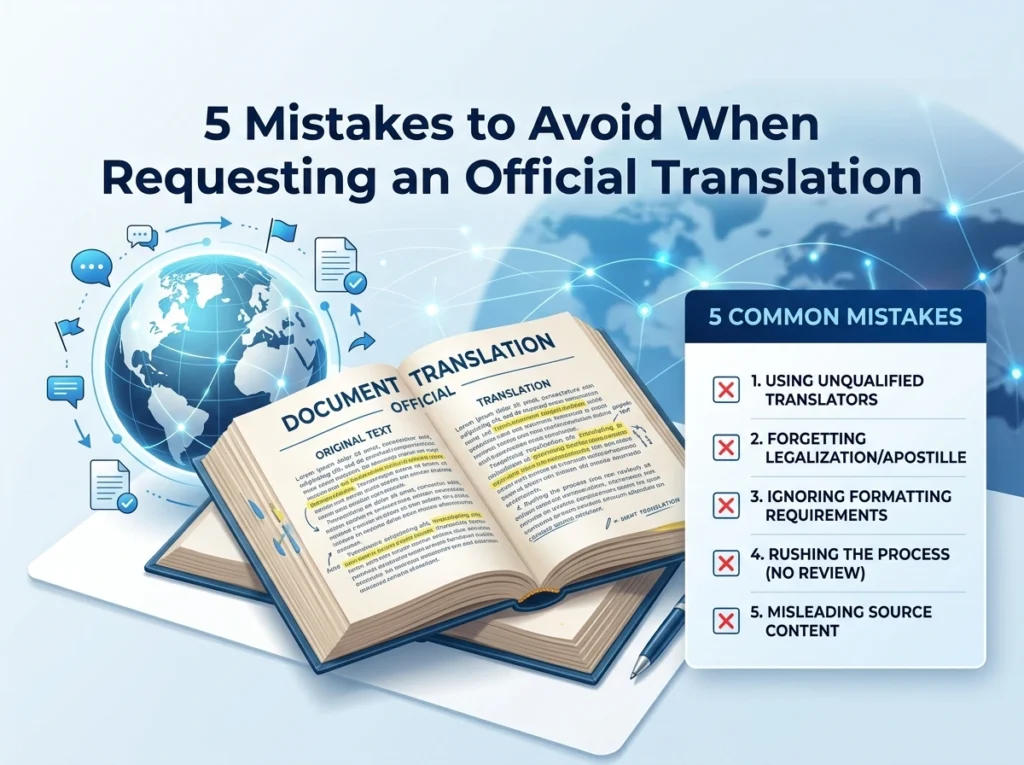
Submitting foreign-language documents requires careful attention to detail. Many applicants make avoidable errors that compromise their entire case. Here are the top mistakes you should avoid when preparing your documents.
Failing to check specific requirements
Different institutions have highly specific demands for translated documents. A common error is confusing a certified translation with a notarized translation.
A certified translation includes a signed and dated Certificate of Accuracy from the professional translator. This statement affirms that the translation is a complete and accurate rendering of the original document. USCIS and most university admissions boards explicitly require this certification.
A notarized translation adds another layer of legal authentication. For a notarized document, a notary public must witness and stamp the translator’s certification. Civil courts, the Department of Motor Vehicles (DMV), and banks often require notarization. If you submit a standard certified translation to a court that demands notarization, the clerk will reject your paperwork. Always verify the exact submission requirements with the receiving agency before you order your translation.
Providing poor quality source documents
Translators can only translate what they can clearly read. If you provide a blurry photograph, a cutoff scan, or a document obscured by shadows, the translator will struggle to produce an accurate result. Professional translators cannot guess or assume missing information. If a section of your birth certificate or academic transcript is illegible, they must note it as “illegible” on the final certified document.
Having “illegible” stamps scattered across your paperwork looks unprofessional and can trigger application delays. Take the time to create high-quality, high-resolution scans of your original documents. Ensure that all stamps, seals, signatures, and margins are clearly visible.
Waiting until the last minute
Legal and immigration processes operate on strict deadlines. Waiting until the day before your submission deadline to request a translation is a massive risk. While standard turnaround times for document translation usually range from one to three business days, complex or lengthy documents take longer.
Rushing the process also limits your ability to review the final files before submission. If an obscure town name or a unique family surname is misspelled, you need time to request a correction. Give yourself a comfortable buffer of at least one to two weeks. If you find yourself in an emergency, some professional services offer expedited processing, but planning ahead eliminates that extra cost and panic.
Not verifying the translator’s credentials
You cannot simply ask a bilingual friend or family member to translate your documents for official purposes. Government agencies require translations to be completed by competent professionals.
USCIS regulations state that the translator must certify that they are competent to translate the foreign language into English. If the translation looks unprofessional, contains grammatical errors, or lacks a formal Certificate of Accuracy, the agency will issue a Request for Evidence (RFE). This delays your case by months. To ensure compliance, always work with translators or translation companies that have verifiable credentials, such as membership in the American Translators Association (ATA).
Ignoring industry-specific terminology
A standard bilingual speaker might know conversational terms, but official documents rely on highly specific vocabulary. Legal contracts, medical records, and university transcripts contain specialized jargon that must be translated with exact precision.
For example, a medical record requires strict adherence to anatomical and pharmaceutical terminology. A minor mistranslation in a medical file can cause massive confusion for healthcare providers or insurance companies. Similarly, legal contracts require precise phrasing to remain legally binding. Using a general translator for a specialized document is a major mistake. You must rely on professionals who understand the specific vocabulary of your industry.
The Importance of Professional Services
Partnering with a professional translation agency eliminates the guesswork from your application process. Professional services employ native-speaking translators who understand the rigid formatting and certification requirements of US government bodies.
When you use a professional service, you receive a guarantee of acceptance. Established companies know exactly what USCIS, federal courts, and credential evaluation boards expect to see. They format the translated document to mirror the original file, making it easy for government officials to compare the two. They also provide the necessary Certificate of Accuracy on official company letterhead. This level of professionalism builds trust with the reviewing official and drastically reduces the chances of your document being questioned or rejected.
How to Request an Official Translation Correctly
Getting your documents translated properly is a straightforward process if you follow the right steps.
First, confirm the exact requirements with the organization receiving your documents. Ask them explicitly if they need a certified translation, a notarized translation, or an apostille authentication.
Second, prepare your files. Scan your documents using a proper scanner or a high-quality mobile scanning app. Verify that every word, seal, and signature is legible.
Next, choose a reputable translation provider. You can request an official translation from an established company that guarantees USCIS acceptance and offers transparent pricing. Provide them with your clean digital files and clearly state your required turnaround time.
Finally, review the completed translation carefully before you submit it to the government. Check the spelling of all proper nouns, including names, cities, and institutions. Once you verify the accuracy, you can confidently download the files and include them in your application package.
Frequently Asked Questions
Can I translate my own documents for USCIS?
No. Even if you are completely fluent in both English and the language of the original document, you cannot translate your own paperwork for USCIS. You must use a competent, independent translator who can provide a signed Certificate of Accuracy.
Do I need to mail my original documents to the translator?
In most cases, you do not need to part with your original documents. Professional translation services operate digitally. You can upload secure photos, scans, or PDFs of your paperwork. The agency will translate the digital file and email you the certified PDF, which is widely accepted by institutions nationwide.
How much does a certified translation usually cost?
Pricing generally depends on the page count rather than the word count. A standard rate for a professional agency is usually around $30 per page. Additional services like notarization or expedited turnaround times will incur extra fees.
Secure Your Document Approval Today
Failing to properly translate your official documents can derail your most important life plans. Whether you are applying for a green card, enrolling in an overseas university, or transferring a foreign vehicle title, precision is your best asset.
By understanding the difference between certification and notarization, preparing clear source files, and respecting timelines, you protect your application from unnecessary delays. Do not leave your vital records to chance or risk rejection due to a technicality. Rely on professional language experts to bridge the communication gap, and move forward with your application confidently
