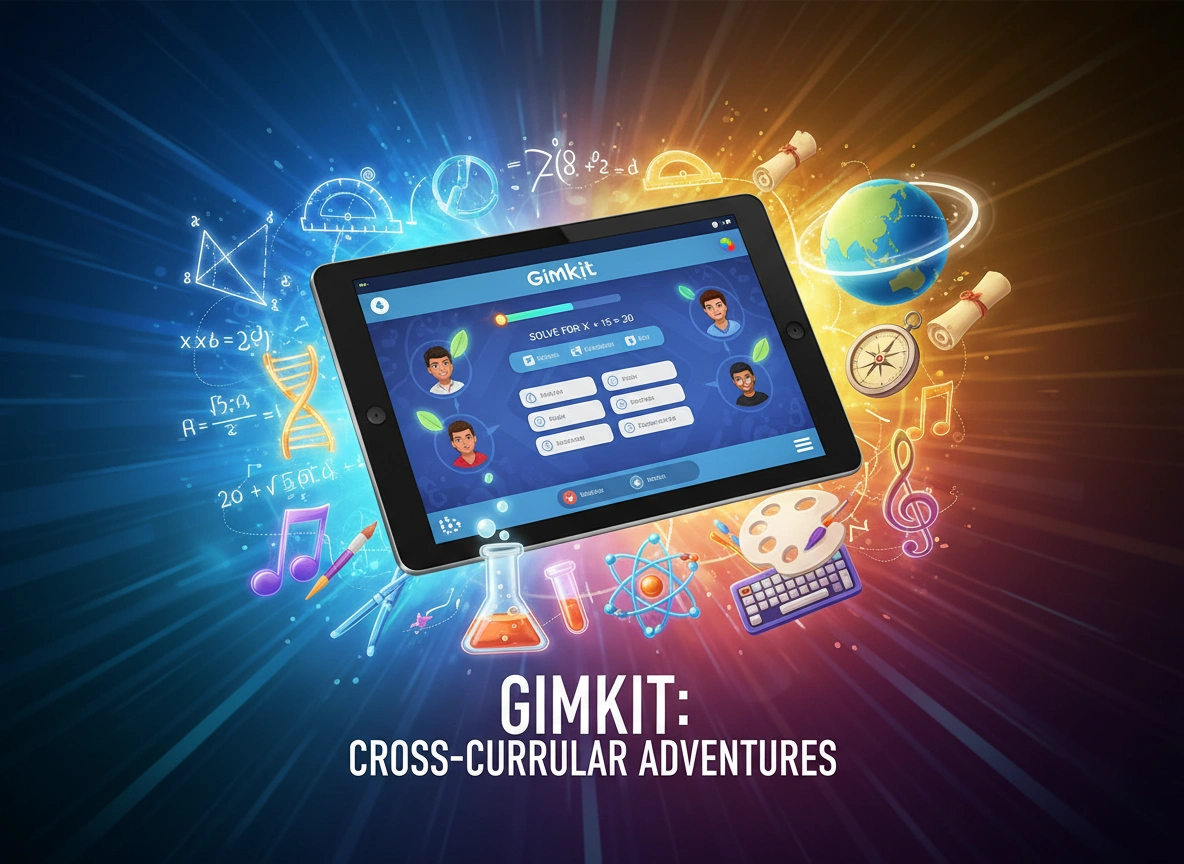
Educators are constantly searching for innovative tools that can capture students’ attention while reinforcing core academic concepts. One platform that has gained significant traction is Gimkit, a game-based learning tool that transforms the traditional quiz into an engaging and competitive experience. While many use it for subject-specific review, its true power lies in its adaptability for cross-curricular learning. By weaving together different subjects, teachers can create rich, memorable lessons that show students how knowledge is interconnected.
This guide will explore how you can leverage Gimkit to break down subject silos and foster a more holistic understanding in your classroom. We will cover its core features, provide practical examples for various subjects, and offer tips to maximize its educational impact.
What Is Gimkit? A Quick Overview
Gimkit was famously created by a high school student who wanted to make a learning game he and his friends would actually want to play. This student-centric origin is evident in its design. At its heart, Gimkit is a quiz platform where students answer questions to earn in-game currency. They can then use this currency to buy power-ups and upgrades, adding a layer of strategy that goes beyond simply knowing the right answer.
Unlike other quiz games where the fastest player with the most correct answers always wins, Gimkit’s strategic elements level the playing field. A student who answers questions accurately but methodically can still win by investing their earnings wisely. This unique blend of knowledge and strategy makes it highly engaging for a wide range of learners.
Key features that make Gimkit a versatile tool for educators include:
- Live Game Modes: From classic “Cash” mode to team-based “Capture the Flag” and strategic “Trust No One,” the variety keeps the experience fresh.
- Assignments (Homework): Assign “Kits” (question sets) for independent practice, which students can complete at their own pace.
- KitCollab: A collaborative feature where students can contribute questions to a single Kit, promoting teamwork and ownership of the learning material.
- Flexible Question Formats: Create multiple-choice questions or text input answers to suit different learning objectives.
- Detailed Reports: After each game, teachers receive comprehensive reports detailing student performance, highlighting areas of strength and topics that need further review.
The Power of Cross-Curricular Connections
Cross-curricular teaching involves integrating skills, knowledge, and concepts from multiple subject areas into a single lesson or project. This approach helps students see the relevance of what they are learning by connecting it to the real world, where problems are rarely confined to one discipline.
Using a tool like Gimkit for this purpose offers several distinct advantages:
- Boosts Engagement: The gamified nature of Gimkit makes reviewing complex, multi-subject topics more exciting and less intimidating.
- Reinforces Knowledge Holistically: By blending subjects, you help students build stronger, more interconnected neural pathways. A historical event isn’t just a date; it’s linked to the geography, science, and literature of its time.
- Develops Critical Thinking: Cross-curricular questions often require students to synthesize information from different domains, pushing them beyond simple recall.
- Enhances Collaboration: Team-based game modes encourage students to pool their diverse knowledge to solve problems, mirroring real-world teamwork.
Integrating Gimkit Across the Curriculum: Practical Examples
The key to effective cross-curricular use of Gimkit is designing thoughtful questions that bridge two or more subjects. You can create a single “Kit” that combines all subjects or create separate Kits that build on a central theme.
Here are some examples of how to merge different subjects within a Gimkit game:
1. History and Language Arts
Combine historical events with the literature and vocabulary of the era. This helps students understand that language and stories are products of their time.
- Theme: The Harlem Renaissance
- History Question: Which major event, known as the “Great Migration,” contributed to the growth of Harlem in the early 20th century?
- Language Arts Question: The poem “I, Too” by Langston Hughes is a powerful response to Walt Whitman’s poem “I Hear America Singing.” What is the central theme of “I, Too”?
- Vocabulary Question: In his essays, W.E.B. Du Bois described the concept of “double-consciousness.” What does this term mean?
2. Science and Math
Many scientific principles are expressed through mathematical formulas. A Gimkit game can help students practice both the conceptual understanding and the practical application.
- Theme: Physics of Motion
- Science Question: What is the definition of acceleration? (A: The rate of change of velocity).
- Math Question: A car accelerates from 0 m/s to 20 m/s in 5 seconds. What is its acceleration? (Formula: a = Δv / t). (A: 4 m/s²).
- Conceptual Math/Science Question: If two objects of different masses are dropped in a vacuum, which one will hit the ground first? (A: They will hit at the same time).
3. Geography and World Cultures
Connect physical locations with the art, traditions, and societal norms of the people who live there. This provides context to maps and helps humanize different cultures.
- Theme: Ancient Egypt
- Geography Question: The ancient Egyptian civilization was heavily dependent on the annual flooding of which river? (A: The Nile River).
- World Cultures/Art Question: What was the primary purpose of the elaborate hieroglyphs and paintings found inside pyramids? (A: To guide the deceased in the afterlife).
- Science/Engineering Question: The pyramids at Giza are a marvel of ancient engineering. What simple machine was likely crucial for lifting the massive stone blocks? (A: Ramps/Inclined planes).
4. Art and Math
Demonstrate the hidden mathematical principles behind beautiful works of art, from classical paintings to modern architecture.
- Theme: The Golden Ratio
- Art History Question: Which famous Renaissance painting by Leonardo da Vinci is often cited as an example of the Golden Ratio in its composition? (A: The Mona Lisa or The Last Supper).
- Math Question: The Golden Ratio is an irrational number approximately equal to…? (A: 1.618).
- Application Question: A rectangle has a width of 10 cm. To be a “Golden Rectangle,” its length should be approximately…? (A: 16.18 cm).
Maximizing Gimkit’s Potential in Your Classroom
To get the most out of Gimkit for cross-curricular learning, consider the following tips:
- Start with a Central Theme: Base your Kit around a compelling theme, project, or essential question. This provides a natural anchor for connecting different subjects. For example, a theme like “Exploration” could include the history of famous explorers, the science of navigation, the math behind cartography, and literature about adventure.
- Use KitCollab for Student-Led Creation: Turn the creation process over to your students. Divide them into “subject expert” groups (e.g., History, Science, Math) and have each group contribute questions related to the central theme using KitCollab. This promotes ownership, research skills, and collaboration.
- Leverage Different Game Modes for Different Goals: Use a fast-paced live game like “Cash” for a fun, high-energy review. For deeper, more strategic thinking, try a team mode like “Capture the Flag,” where students must discuss answers and coordinate their efforts.
- Use Reports for Formative Assessment: After a game, review the report. Did the entire class struggle with the math-related questions? Were the language arts concepts well understood? Use this data to inform your next steps. You can identify both individual and class-wide learning gaps that span across subjects.
- Go Beyond Multiple Choice: While multiple-choice is fast, text input questions require students to recall information without cues. A text input question like, “Name the scientific principle that explains why ships float,” requires a deeper level of understanding than selecting from a list.
- Create “Quest” Narratives: Frame your Gimkit session as a story or quest. For example: “We are a team of archaeologists uncovering a lost city. To decipher the clues, we need to answer questions about the city’s history, translate its language (Language Arts), and calculate the dimensions of its buildings (Math).” This narrative context makes the learning feel more purposeful.
A Tool for Connected Learning
Gimkit is more than just a digital flashcard game; it is a dynamic platform that can help you build bridges between disciplines. By designing thoughtful, cross-curricular activities, you can foster a classroom environment where students see learning not as a series of isolated facts, but as a rich tapestry of interconnected ideas. This approach not only makes lessons more engaging but also equips students with the critical thinking and problem-solving skills they need to thrive in a complex world. Start small, pick a theme, and watch your students’ engagement and understanding grow.
Please visit the official site for more info.