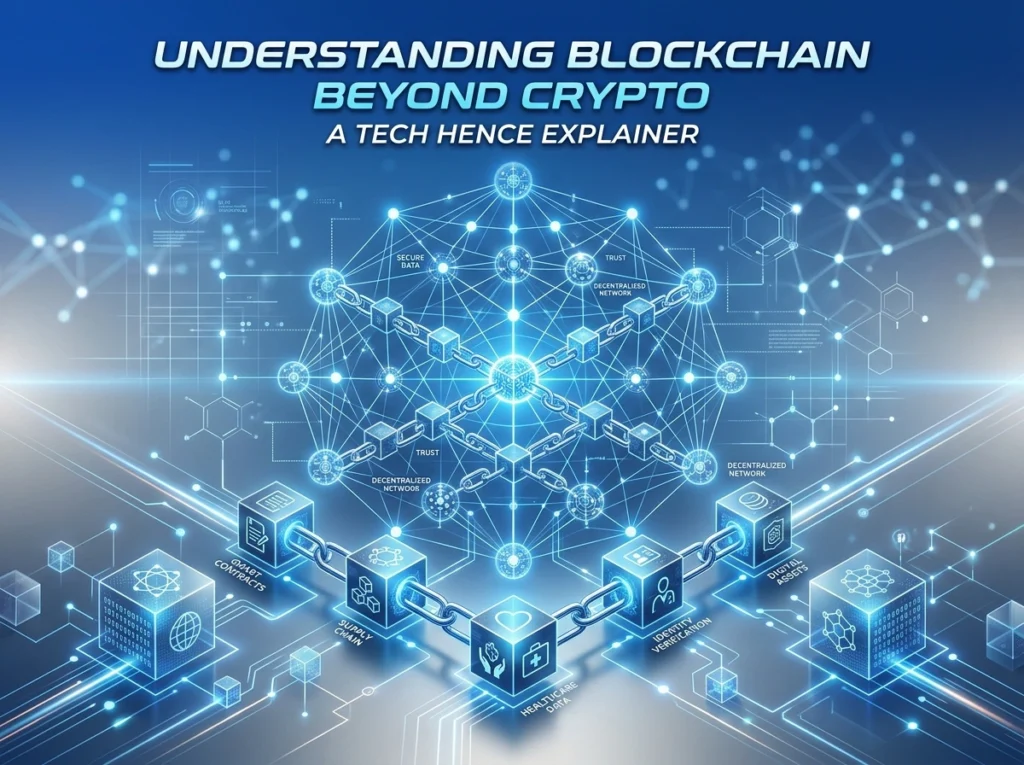
Say the word “blockchain,” and most people immediately picture Bitcoin, wild price swings, and headlines about digital fortunes made overnight. That connection is understandable. Cryptocurrency introduced blockchain to the world. But it also created a giant blind spot. Crypto is just one application of a much broader technology—and arguably not even the most transformative one.
Across the United States, businesses in healthcare, logistics, banking, and government are quietly building on blockchain to solve problems that have nothing to do with trading tokens. Understanding what blockchain actually does, and where it delivers real value, matters more now than ever. So let’s clear away the noise and look at the technology on its own terms.
What Blockchain Really Is
At its core, a blockchain is a shared digital ledger. Think of it as a record book that many people hold copies of at once. When something new gets written into that book, every copy updates, and no single person can secretly change an earlier entry.
Three features make this powerful:
- Decentralization: No single company or server controls the record. The data lives across a network of computers.
- Immutability: Once information is confirmed and added, altering it is practically impossible. Each new “block” of data links to the one before it using cryptography.
- Transparency: Depending on the setup, participants can verify transactions without needing a middleman to vouch for them.
That combination creates something valuable: trust without a central authority. You don’t have to trust a bank, a broker, or a vendor to confirm a record is accurate. The system itself provides that assurance.
Public vs. Private Blockchains
Not all blockchains work the same way. Public blockchains, like the networks behind Bitcoin and Ethereum, are open to anyone. Private or permissioned blockchains restrict access to approved participants. Most enterprise use cases in the U.S.—especially in regulated industries like finance and healthcare—rely on permissioned networks. They offer the benefits of shared, tamper-resistant records while keeping sensitive data controlled and compliant.
Blockchain in Supply Chain Management
Supply chains are complicated. A single product might pass through dozens of hands—manufacturers, shippers, distributors, and retailers—across multiple states and countries. Tracking where something came from and whether it’s authentic has always been a headache.
Blockchain changes that. By recording each step on a shared ledger, everyone in the chain sees the same verified information in real time.
Consider food safety. Major U.S. retailers now use blockchain to trace produce from farm to shelf. When contamination is discovered, the source can be identified in seconds rather than days. That speed protects consumers and limits costly recalls. The same idea applies to pharmaceuticals, luxury goods, and electronics, where counterfeiting and fraud cost billions each year.
Transforming Healthcare Records
Healthcare in America runs on data that’s often scattered, siloed, and hard to share safely. Your medical history might live in one hospital’s system, your prescriptions in a pharmacy’s, and your lab results somewhere else entirely. Moving that information securely—while staying compliant with HIPAA—is a constant struggle.
Blockchain offers a smarter approach. Patient records stored on a permissioned ledger can be shared across providers with the patient’s permission, without creating a vulnerable central database. Every access and update is logged, creating a clear audit trail.
The benefits are real:
- Better care coordination between doctors, specialists, and hospitals.
- Reduced fraud in billing and insurance claims.
- Stronger patient control over who sees personal health information.
For a country with a famously fragmented healthcare system, this kind of interoperability could be a genuine breakthrough.
Reinventing Finance and Payments
Yes, finance is where crypto lives—but blockchain’s impact on money goes far beyond speculation. Traditional financial systems rely on layers of intermediaries. Every transaction passes through banks, clearinghouses, and settlement systems, each adding time and cost.
Blockchain streamlines this. Cross-border payments that once took days can settle in minutes. Banks and fintech firms are adopting the technology to cut costs and speed up transactions.
A few standout applications:
- Faster settlements: Trades and transfers clear almost instantly instead of over several business days.
- Lower fees: Fewer middlemen means lower costs for businesses and consumers.
- Financial inclusion: People without access to traditional banking can participate through digital wallets.
Regulators are paying close attention. As the technology matures, expect clearer rules that let institutions adopt blockchain confidently while protecting consumers.
Smart Contracts: Agreements That Run Themselves
One of blockchain’s most exciting features is the smart contract. This is a self-executing agreement written directly into code. When the agreed conditions are met, the contract acts automatically—no lawyers or middlemen required.
Picture an insurance policy for flight delays. If a flight is delayed beyond a set time, a smart contract could verify the delay through a data feed and pay the customer instantly. No claims process, no waiting.
Smart contracts are already reshaping:
- Real estate, by automating property transfers and escrow.
- Insurance, by speeding up claims and reducing disputes.
- Legal agreements, by enforcing terms without manual oversight.
The result is faster, cheaper, and more reliable transactions—with fewer chances for human error or dispute.
Digital Identity You Actually Control
Identity theft remains a serious problem in the U.S., costing consumers and companies enormous sums each year. Part of the reason is that our personal data sits in countless databases we don’t control, each one a potential target.
Blockchain-based digital identity flips that model. Instead of companies storing your data, you hold verifiable credentials in a secure digital wallet. When a service needs to confirm your identity, you share only what’s necessary—and nothing more.
This approach, often called self-sovereign identity, means:
- You decide who accesses your information.
- Companies store less sensitive data, reducing breach risk.
- Verification becomes faster and more secure across platforms.
From logging into services to proving your credentials online, self-sovereign identity could redefine digital trust.
Why This Matters Now
Blockchain is no longer an experiment. It’s becoming infrastructure—the quiet plumbing behind systems we rely on daily. As adoption grows across American industries, understanding the technology gives businesses and individuals a real edge. Staying informed about emerging tech through resources like tech hence helps you separate genuine innovation from hype.
The organizations that win won’t be the ones chasing buzzwords. They’ll be the ones asking a simple question: where does a shared, tamper-resistant record actually solve a problem? When the answer is clear, blockchain delivers value that traditional systems can’t match.
The Bottom Line
Cryptocurrency opened the door, but it was never the whole story. Blockchain’s true promise lies in its ability to create trust, transparency, and efficiency across industries that touch our everyday lives—the food we eat, the care we receive, the money we move, and the identities we protect.
The technology still faces hurdles. Regulations are evolving, energy concerns need addressing, and adoption takes time and investment. But the direction is clear. Blockchain is quietly building a more transparent and secure foundation for how we exchange value and information.
So the next time you hear “blockchain,” look past the crypto headlines. The real revolution is happening in supply chains, hospitals, banks, and beyond—and it’s just getting started.
